15.09.2026

Meditations
05.07.2026
Olga Ponomarenko
Read 15 minutes

When you try meditation for the first time, breathing can seem like the easiest part of the practice. But the moment you start paying attention to it, questions come up: Should you breathe more deeply? Use only your belly? Count the seconds? Make the exhale deliberately slower? A natural process can quickly turn into one more thing you feel you have to do ‘correctly’.
In most mindfulness practices, it is much simpler. You do not need to keep correcting your breath or fit it into a set pattern. Instead, breathing becomes an anchor you return to whenever you notice that your mind has drifted into thoughts. Controlled breathing exercises are different: there, you intentionally change the rhythm to relax or improve focus.
The key is to distinguish breath meditation from separate breathwork techniques. Below, we will look at both: first, how to breathe during a basic meditation practice, and then a few simple patterns you can use as additional breathing exercises.
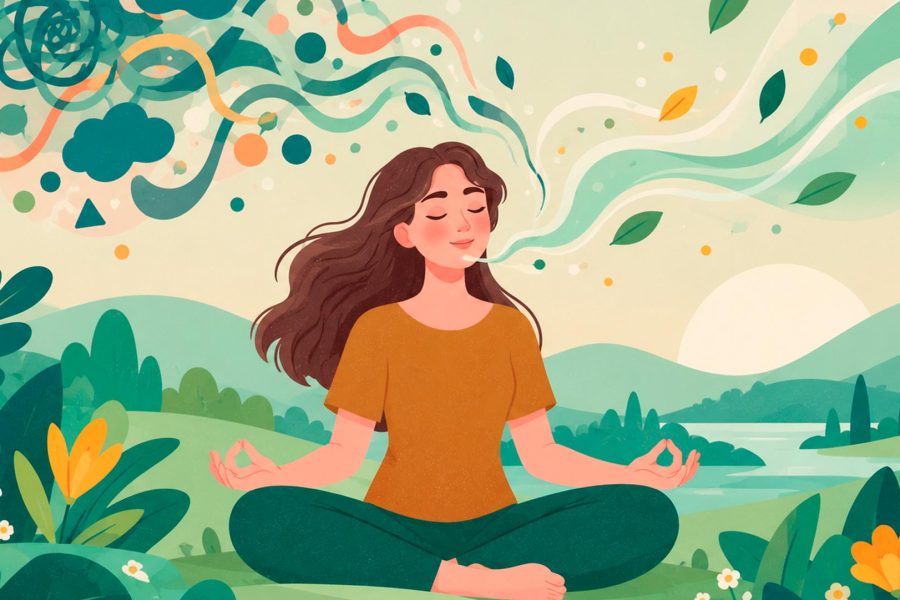
During a regular meditation, let your breath be as it is in that moment. Do not try to fill your lungs completely or make every breath the same. In its guidance for beginners, UCLA Health suggests noticing the natural movement of the chest as you inhale and exhale, then gently returning to that sensation whenever your attention wanders.
If it feels comfortable, breathe through your nose. For a calm practice, this is a natural option, but it is not a strict rule. A blocked nose or discomfort is reason enough not to force a particular way of breathing.
There is also no need to fixate on whether you are breathing ‘into your belly’ or your chest. The diaphragm is already involved in normal breathing automatically. Conscious diaphragmatic breathing is a separate exercise. Cleveland Clinic describes it as a technique that helps engage the diaphragm more effectively and may support relaxation.
Another common extreme is making every breath as deep as possible. That does not make meditation more effective. NHS guidance on calming breathing also emphasizes that you should let the breath go only as deep as feels comfortable, without forcing it.
A simple rule is enough: breathing should not become a struggle. If you keep checking whether you inhaled deeply enough, whether your belly moved ‘correctly,’ or whether your exhale was too short, your attention is no longer on the practice – it is on control.
Try meditation now and feel the surge of strength!
Try in the app
You do not need a special posture or complicated technique for your first practice. Find a few quiet minutes when you are unlikely to be interrupted, and start by simply observing your breath.
Many people notice something else: as soon as they start watching their breath, it seems to stop being automatic. It can feel as though every inhale now has to be done consciously. When that happens, do not try to force yourself to ‘let go of control.’ Observe the breath you have right now, even if it feels slightly controlled. The tension usually eases when you stop checking yourself every few seconds.
If your mind moves to your to-do list or random thoughts within a few seconds, try adding a count. It gives your attention a simple structure and can make it easier to stay with the practice.
Count one complete inhale-exhale cycle as 1, the next as 2, and continue up to 10. Then start again. If, somewhere around 6, you suddenly realize you have been thinking about something else for a while, do not try to remember where you stopped. Simply return to 1.
The numbers are not the goal. Counting only helps you notice the moment your attention follows a thought. As it becomes easier to stay with the physical sensations of breathing, you can drop the count.
Mindful observation and controlled breathing are often grouped together, but they are not the same thing. In meditation, you mostly notice the breath’s natural rhythm. In a breathing exercise, you deliberately change it – slowing it down, making it more even, or extending the exhale.
Slow breathing has been studied as a way to influence tension and autonomic nervous system activity. In a systematic review published in Frontiers in Human Neuroscience researchers linked slow breathing practices with changes in heart rate variability and a greater subjective sense of calm. At the same time, the evidence does not support one specific breathing rate as universally best for everyone.
Diaphragmatic breathing
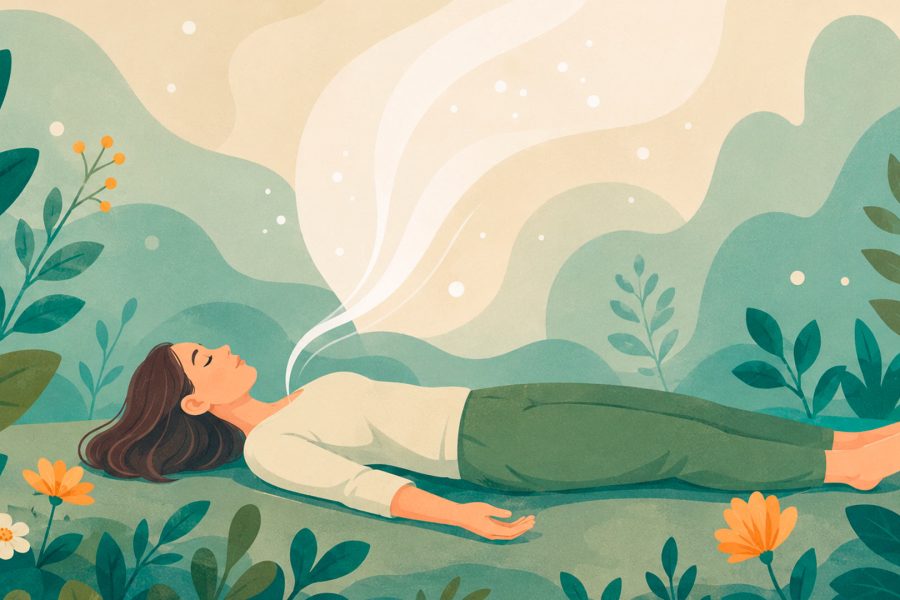
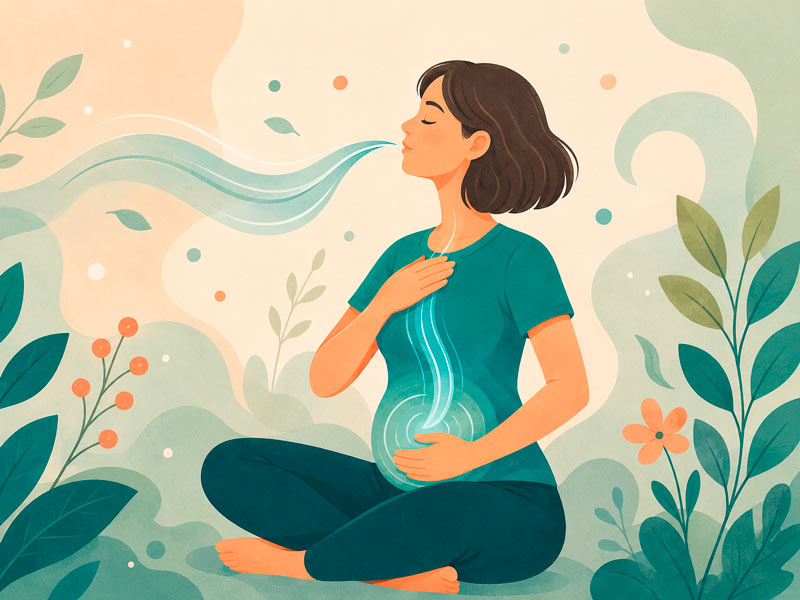
Sit or lie down comfortably. Place one hand on your abdomen and the other on your upper chest. Breathe in gently through your nose and notice your abdomen rise with the inhale. As you exhale, it settles back.
You do not need to push your abdomen out or keep your chest completely still. The point is not to create a perfect range of motion, but to breathe without unnecessary effort in your shoulders and upper body. This technique can be useful for a few minutes before meditation if it is hard to switch from a busy day straight into quiet observation.
5-5 equal breathing
This pattern is simple: about 5 seconds for the inhale and 5 seconds for the exhale, with no breath holds in between.
Five seconds is only a guide. If the 5-5 rhythm makes you stretch the inhale or wait impatiently for the moment you can exhale, shorten the cycle. Comfort matters more than the numbers.
Breathing with a longer exhale
For relaxation, some people find it comfortable to make the exhale slightly longer. You might start with about 4 seconds in and 5-6 seconds out. The difference should stay small and should not leave you feeling short of breath.
Researchers at Stanford Medicine reported an interesting result as well. In a randomized study, they compared brief breathing exercises with mindfulness meditation. Among the techniques tested, cyclic sighing – which emphasizes a longer exhale – showed promising results. This does not mean the exhale always needs to be longer than the inhale, but it does show that some breathing patterns can be useful tools for reducing tension.
Box breathing
In box breathing, one cycle has four parts: inhale, hold, exhale, hold. Each stage is often kept the same length, for example 4-4-4-4.
This pattern can give attention a clear structure, but it is not necessary for ordinary breath meditation. If the pauses after an inhale or exhale cause tension, anxiety, or a sudden urge to breathe in, choose a simpler technique without breath holds.
Most difficulties come not from breathing itself, but from the urge to keep correcting it. When every breath cycle becomes a small test of whether you are doing it ‘right,’ relaxing becomes much harder.
Breathing too quickly or deeply can lead to hyperventilation. Cambridge University Hospitals explains that overbreathing lowers carbon dioxide levels in the blood and may be accompanied by dizziness, tingling, trembling, a feeling of breathlessness, or general tension.
That is why breathing practice is not about chasing longer cycles or ‘deeper’ sensations. If a technique stops feeling comfortable, return to your normal breathing.
Sometimes focusing on the breath has the opposite effect: a normal inhale suddenly feels too short, and you keep wanting to sigh, yawn, or take in more air. It is especially easy to get caught in this loop when you start checking every breath.
In that situation, stop counting, holding your breath, or following a set pace. Relax your shoulders and let your breathing settle on its own for a few minutes. Do not try to ‘fix’ the sensation with a series of large breaths – that can make overbreathing worse.
Meditation does not have to feel pleasant every time. NCCIH notes that although mindfulness and meditation are generally considered low-risk practices, some people can experience unwanted effects, including increased anxiety.
If you develop severe dizziness, significant shortness of breath, pain, a feeling that you may faint, or another marked change in how you feel, stop the practice. If these symptoms keep returning or also happen outside meditation, discuss them with a doctor.
The breath is a popular meditation anchor, but it is not the only one. For some people, watching every inhale quickly turns into monitoring and makes them more tense. If that happens, there is no reason to force it.
Instead of the breath, try focusing on:
The basic principle stays the same: choose a clear point of attention, notice when your mind wanders, and return. NCCIH’s overview of meditation and mindfulness also mentions the breath, sounds, images, and mantras as possible points of focus.
You do not need to start with long sessions. If you are new to the practice, a few minutes is enough to understand the basic idea without turning meditation into a test of endurance.
UCLA Health suggests that beginners can start with as little as 1-2 minutes and gradually increase the length of their sessions. In practice, 3-5 minutes is a comfortable starting point; once that feels familiar, you can move to 7-10 minutes or longer.
Duration on its own says very little. Five minutes in which you notice your mind wandering a few times and return to the breath is already a complete practice. Returning regularly matters more than sitting for half an hour once while constantly wondering whether you are doing everything right.
The best way to breathe during meditation is to keep it comfortable rather than turn it into a struggle. For a basic practice, it is enough to sit comfortably, let the breath follow its own rhythm, and notice the sensations of inhaling and exhaling. When your attention wanders, simply bring it back.
Counting, diaphragmatic breathing, a 5-5 rhythm, a longer exhale, and box breathing can all be useful additional tools, but none of them is a requirement for meditation. Choose the approach that keeps your breathing comfortable and does not make you hold your attention by force.
Meditation does not begin with a perfect breath. It begins with the simple moment when you notice that you are breathing – and stay with that sensation for a few seconds.
I improve my mental state: