05.06.2026

Sleep
02.06.2026

Olha Ponomarenko
Read 8 minutes

Waking up in the middle of the night bothers many people. Sleep problems are exhausting, drain energy, cause irritability, and leave you feeling tired after waking up. Meditation helps restore your physical and emotional state and minimize nighttime awakenings. The practice is based on the natural mechanism of calming and restoring the nervous system. 10-15 minutes of meditation before bedtime will help reduce tension, calm the flow of thoughts, and get a good night’s sleep.
Waking up in the middle of the night is a phenomenon that can be caused by a number of reasons. The most common of these is chronic overexcitement caused by factors such as the following:
Under such conditions, the nervous system is constantly active, without time to recover. The brain remains overly active even during sleep, which often leads to restless sleep and frequent awakenings. The quality of sleep is also affected by the daily routine: going to bed late, prolonged use of gadgets before bedtime, or the lack of a regular daily routine.
Personal physiological and biochemical factors remain an important factor in the duration and quality of sleep. Sleep disturbances can occur as a result of hormonal changes in the body and problems with the respiratory system. Finally, quality rest can be disrupted by external conditions. If the room is too hot, cold, too bright, or the body is in an uncomfortable position, the body wakes up to make sure that we are not in danger.
Any sleep problems are a reason to pay attention to your psycho-emotional state, daily habits, and health. Lack of rest is harmful to the body and can have serious consequences. One of the first steps towards restoring quality sleep can be evening meditation. Simple exercises will help activate recovery processes on a physical and psychological level.
I improve my mental state:

Meditation before bed is a gentle and effective way to calm the nervous system before falling asleep, as well as to prepare the body and mind for deep recovery. Most techniques help normalize your heart rate and get rid of intrusive thoughts that prevent you from falling asleep. Thanks to the activation of the parasympathetic nervous system, which is responsible for relaxation, the level of cortisol, the stress hormone, decreases in the body.
Meditation not only helps you relax and fall asleep more easily, but also directly affects the quality of your sleep. These practices help prolong the deep sleep phases and reduce the number of nighttime awakenings. Gradually, the feeling of “broken” in the morning will disappear.
Practicing daily will help you create your own bedtime ritual. Practice meditation regularly and at approximately the same time. In just a few weeks, your brain will learn a new habit: “I meditate in the evening” — “I will sleep soon.” This will make it easier for you to fall asleep, and your sleep will become deeper and more restful.
Progressive muscle relaxation
Progressive muscle relaxation is a technique that involves sequentially tensing and relaxing different muscle groups. It was developed by American physician Edmund Jacobson, who proved that physical tension is directly related to emotional tension. When individual parts of the body are relaxed, anxiety levels decrease and the mind becomes clearer and calmer.
To perform:
After completing the exercise, perform a body scan. Notice how the sensations in your body and its individual parts have changed.

Visualizing a peaceful place
Visualizing a peaceful place is a meditative practice based on imagining yourself in a safe, peaceful space. You mentally create an imaginary space where you feel comfortable and harmonious. In fact, it can be any location that has a similar effect: a beach, a clearing in the forest, a room, etc.
To perform this meditation:
The effectiveness of this practice lies in the fact that our brain reacts the same way to real and imaginary events on a biochemical level. The imaginary image you create allows you to experience what you need in the most realistic way possible. During this process, the parasympathetic nervous system is activated and the body enters a recovery mode. As a result, it becomes easier to fall asleep, and the sleep itself becomes deeper and of higher quality, minimizing the number of nighttime awakenings.
Conscious breathing
Conscious breathing is a simple but effective practice that helps redirect your attention from anxious thoughts to bodily sensations. The essence is to focus completely on the process of breathing. You pay attention to its rhythm, depth, and the movement of air in your body. This focus calms the nervous system, slows the pulse, and promotes natural relaxation.
To perform:
This exercise can be performed both for relaxation and for falling asleep. It quickly reduces anxiety, relieves tension, and helps you recover from stress. If you do it regularly, you will learn to fall asleep faster, and your sleep will become better.
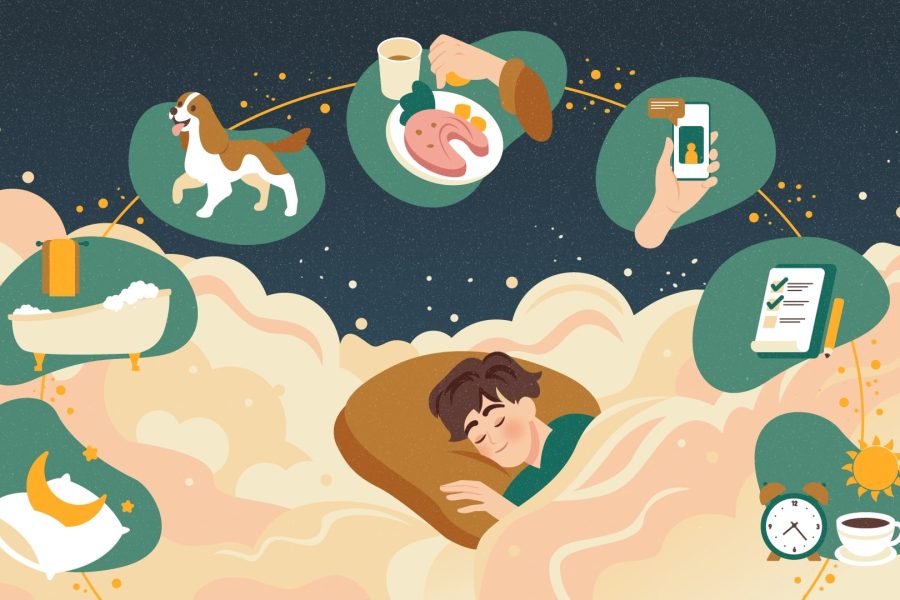
To reduce the number of nighttime awakenings and normalize your sleep, you should also review your evening habits. To normalize your rest:
These simple actions, combined with meditation, will significantly improve your sleep. Our app will help you choose practices and meditations so that the problem of waking up in the middle of the night becomes a thing of the past.